French law provides startups with a variety of incentive solutions designed to retain employees (free stock grants, stock options, etc.). Among these tools, the issuance of founder stock warrants (BSPCE) is one of the most common.
This is because BSPCEs are an excellent tool for startups seeking to attract and retain new talent and motivate them to actively participate in the company’s growth during its development phase. As such, they are now an essential component of the overall compensation policy for startups and growing SMEs.
But more specifically, what is a BSPCE? Which companies are eligible? And who can benefit from them?
This article will help you understand everything about how BSPCEs work and their scope of application.
What is a BSPCE?
Designed for young companies, entrepreneur share subscription warrants (BSPCE) are intended to promote employee ownership. They encourage certain employees to participate in and support the company’s growth.
A BSPCE is a warrant (a “right”) that grants the beneficiary the option to subscribe to shares of the issuing company at a price determined at the time the warrants are granted. Upon subscribing for shares, the beneficiary becomes a shareholder and may exercise the rights attached to that status (e.g., voting rights, dividend rights, depending on the nature of the securities and the articles of incorporation).
What are its characteristics?
BSPCE shares have certain characteristics that make them a unique tool for employee equity participation:
- The warrants are granted free of charge;
- They allow beneficiaries to subscribe to shares representing a portion of the company’s capital at a price fixed on the date of their grant;
- The warrants are issued in the name of the specific recipient and are therefore non-transferable;
- The warrants are personal in nature and are therefore non-transferable.
- They may entitle the holder to a specific tax treatment: in practice, the categories of gains (and their taxation) must be distinguished based on the applicable laws and the beneficiary’s circumstances
How do they work?
BSPCE shares are granted free of charge by the issuing company to a beneficiary. The terms and conditions must be established:
- the type and number of underlying shares (often, one warrant corresponds to one common share, but this is not a requirement)
- vesting schedule
- exercise price
Once vested, the warrant becomes exercisable: the beneficiary may purchase the share at the price set at the time of grant.
The benefit of the BSPCE for the beneficiary lies in the fact that the price is determined in advance. If the company’s value increases between the grant and the exercise (and subsequent sale), the beneficiary can potentially realize a capital gain.
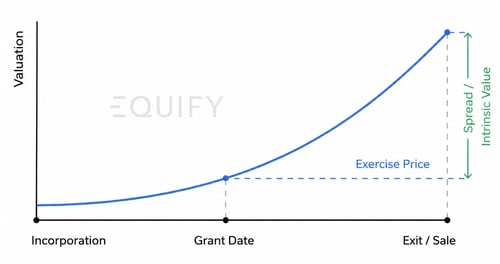
The vesting schedule
The “vesting schedule” (or “vesting period”) refers to the time required for the BSPCE options to vest fully with the beneficiary and become exercisable.
It is often linked to the beneficiary’s length of service with the issuing company. In rarer cases, it may be contingent on performance criteria.
In practice, many companies adopt a total vesting period of 4 years, sometimes with a one-year “cliff” (during which an initial tranche, generally amounting to 25% of the total granted, is released), followed by gradual vesting (monthly or quarterly). These are market practices that should be tailored on a case-by-case basis.
.png?width=400&height=267&name=website%20(15).png)
The exercise price
Historically, the exercise price had to be based on the value of the shares at the time of the most recent funding round if that round had taken place less than six months earlier.
Since thePACTE Act of May 22, 2019, the framework has become more flexible. Article 163 bis G of the General Tax Code (CGI) now allowsfor a discount on the exercise price relative to the price paid by investors, provided that the underlying shares do not carry the same rights (e.g., no liquidation preference, limited voting rights).
A major update to the BOFiP (Official Bulletin of Public Finance) published on March 27, 2024, clarified and solidified the terms of this discount:
- Recognition of Illiquidity: The tax authorities now explicitly acknowledge that a discount may be applied to account forthe illiquidity of the securities (difficulty in reselling unlisted shares).
- Combination of Discounts: It is now possible to justify an exercise price lower than that of the most recent capital raise by combining the discount for the absence of preemptive rights (provided for by the PACTE Act) and the illiquidity discount (confirmed by the BOFiP).
- Valuation Methods: The BOFiP specifies that the value of the securities may be determined using recognized financial methods (cash flow, comparable companies), thereby offering an alternative to simply referring to the price of the most recent capital raise.
Although the tax authorities are more open to the practice of applying a discount, they require greater rigor. The justification for the value selected and the discount applied must be supported by detailed documentation (valuation report or comparative analysis of rights) to prevent any risk of reclassification as a salary benefit.
Which companies can grant BSPCE options?
Because the BSPCE program offers tax advantages, it is reserved for a specific category of companies. To be able to issue and grant BSPCE options, a company must meet the legal requirements set forth in Article 163 bis G of the Tax Code.
To date, the conditions generally outlined include, in particular:
1️⃣ Be a corporation (société anonyme, simplified joint-stock company, or limited partnership with share capital). Other corporate forms, particularly limited liability companies (SARLs), cannot use this mechanism to reward their employees.
2️⃣ The company must have been registered with the RCS ( Registre du Commerce et des Sociétés) for less than 15 years.
3️⃣ Be continuously owned, at least 15%, by individuals (or by legal entities that are themselves at least 75% owned by individuals).
4️⃣ Be subject to corporate income tax (IS ) in France .
Since the passage of the 2020 Finance Act, foreign companies may, under certain conditions, issue and allocate BSPCE shares. To do so, the following two conditions must be met:
- The company must be established in an EU (European Union) member state, or in a country or territory that has entered into a specific tax treaty with France;
- The company must also be subject, in the country where its registered office is located, to a tax equivalent to the corporate income tax in France.
5️⃣ In principle, only companies not listed on a regulated market may issue BSPCE.
However, the legislature has provided for an exception for listed companies with a market capitalization of less than 150 million euros.
6️⃣ Finally, companies that were created as part of a merger, restructuring, expansion, or business takeover are excluded from the BSPCE regime .
The Macron Law of August 6, 2015, relaxed this last condition by introducing a few exceptions.
Who is eligible?
The pool of BSPC beneficiaries has gradually expanded to now encompass the entire ecosystem of a growing group.
1. Within the issuing company
This is the historical foundation of the program. The following are eligible:
- Employees: All employees under an employment contract (permanent or fixed-term), regardless of their length of service (subject to the conditions set forth in the grant plan).
- “Employee-like” executives: Corporate officers subject to the tax regime for employees. This includes, in particular, the Chairman, the Chief Executive Officer, and the Deputy Chief Executive Officers of SAS or SA companies.
- Members of governance bodies: Since the 2015 Pacte Law, members of the Board of Directors or the Supervisory Board may also receive them.
2. Within subsidiaries (Direct ownership)
Since 2015, under the Macron Act, a company may also grant BSPCE options to employees and executives of its subsidiaries, provided that:
1️⃣ The issuing company holds at least 75% of the subsidiary’s capital or voting rights;
2️⃣ The subsidiary meets all the conditions mentioned above, with the exception of those relating to capital ownership.
The 2019 Pacte Act further expanded the scope of BSPCE options, which may now also be granted to directors of the issuing company, as well as those of its subsidiaries.
3. Within Subsidiaries (2026 Update)
As of January 1, 2026, the program has been expanded to cover more complex group structures (Article 25 of the 2026 Finance Act). Employees, executives, and members of the governing bodies of subsidiaries are now eligible.
The two key rules of this expansion:
- The indirect ownership threshold: The issuing company must indirectly hold at least 75% of the sub-subsidiary’s capital or voting rights. This percentage is calculated by multiplying the successive ownership percentages (e.g., 90% of Subsidiary A, which owns 85% of Sub-subsidiary B = 76.5% indirect ownership).
- Market Capitalization: For publicly traded companies, the eligibility threshold of 150 million euros in market capitalization is assessed on an aggregate basis. The market capitalizations of the issuing company, its subsidiaries, and its sub-subsidiaries are added together.
Conclusion
BSPCEs are a very common tool for attracting, retaining, and aligning certain profiles with the value creation of a startup. However, this mechanism is subject to specific regulations, and its actual effects (rights attached to the securities, liquidity, taxation, and consequences of an employee’s departure) depend largely on the terms of the plan.
Sources
1. Article 163 bis G - General Tax Code
2. Law No. 2019-486 on Business Growth and Transformation (“Pacte Law”)
3. Law No. 2015-990 of August 6, 2015, on Growth, Economic Activity, and Equal Economic Opportunity
4. BOFiP (Official Bulletin of Public Finance) published on March 27, 2024
5. Article 92 of the 2025 Finance Act
6. Article 141 — Law No. 2015-990 of August 6, 2015, on Growth, Economic Activity, and Equal Economic Opportunity
7. Article 25 of the 2026 Finance Act