Often overlooked, BSPCEs (startup founder share subscription warrants) are a widely used equity incentive mechanism in startups and scale-ups. Their main advantage lies in a tax and social security framework that is generally more favorable than other options (bonus shares, stock options), provided that specific rules are followed.
Note: The BSPCE regime was revised by the 2025 Finance Act and subsequently amended again by the 2026 Finance Act (regarding eligibility requirements and the scope of beneficiaries, particularly within certain corporate groups).
In this guide, you will find:
- what BSPCE entails for the issuing company,
- when and on what the beneficiary is taxed,
- an overview of the applicable tax rates and key considerations,
- reporting requirements for both the company and the beneficiary.
For the issuing company: no cost
Unlike other employee stock ownership plans (stock options or free shares), the issuing company (or, where applicable, the beneficiary’s employer in the case of an intra-group grant) is, in principle, not liable for any specific contribution in connection with BSPCE grants. (CGI, Art. 163 bis G — Legifrance)
Furthermore, the issuance of BSPCE shares generally has no tax implications for the company solely as a result of the grant, exercise, or sale of shares subscribed to following the exercise of the warrants.
For the beneficiary of the securities: an attractive tax regime
The tax treatment of BSPCE warrants is generally advantageous for the beneficiary in several respects:
- the timing of taxation,
- the tax base (what is taxed),
- the tax rate, depending on the circumstances.
When is the beneficiary taxed?
Taxation occurs following the sale of the shares subscribed to upon the exercise of the BSPCE options. No tax is due prior to this sale—neither at the time of grant nor at the time of exercise.
This is a significant advantage: the beneficiary pays tax only after realizing a capital gain.
The calculation rules are generally presented as follows: taxation applies to the net capital gain on the sale, calculated as the difference between:
- the sale price of the securities (net of any fees and taxes paid),
- and their subscription price at the time the warrants are exercised (purchase price).
What is the applicable tax rate?
Article 163 bis G of the General Tax Code governs the tax treatment of gains related to BSPCE warrants.
In practice, the applicable tax regime depends, in particular, on:
- the date of issuance or grant of the BSPCE options,
- the beneficiary’s length of service with the company as of the date of sale,
- and the rules in effect on the date of sale.
There are two income tax rates applicable to the capital gain on the sale: a standard rate and a higher rate.
- Standard Rate
- The standard rate applies only if, on the date of sale, the beneficiary has been working for the company for at least three years.
Important: As of January 1, 2026, the rules for determining length of service (the three-year threshold) may, in certain cases, take into account periods spent with the issuing company, a subsidiary, or an eligible sub-subsidiary, depending on the group’s ownership structure.
- Increased Rate
- The increased rate applies when the conditions for the standard rate are not met, particularly if the beneficiary has been employed by the company for less than three years as of the date of the stock transfer.
The gain is subject to two separate taxes:income tax (IR) and social security contributions (PS).
Summary:
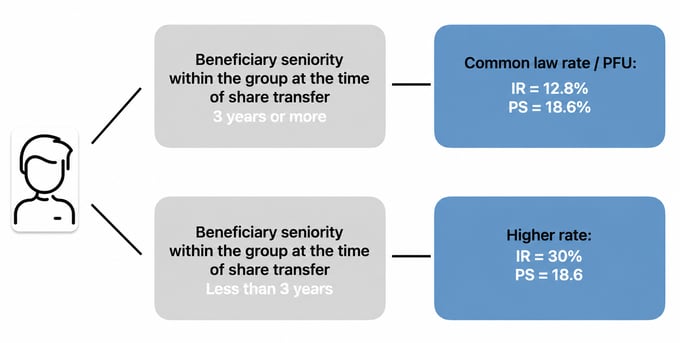
Example: Determining the tax rate based on the beneficiary’s length of service.
Some Limitations
It is generally not possible to combine the benefits of BSPCEs with other savings vehicles: BSPCEs cannot be included in a PEA or in certain employee savings plans, and the same applies to shares acquired through the exercise of BSPCEs.
Reporting Requirements
The issuing company and the beneficiaries are subject to separate reporting requirements. These requirements are set forth, in particular, in Article 41 V bis of Annex III of the CGI.
For the company issuing BSPCE options: an individual statement and the DADS
The company must prepare an individual statement to be provided to each beneficiary who has exercised their BSPCE options. (Annex III of the CGI, Art. 41 V bis — Legifrance)
The information to be included is as follows:
- company name and registered office,
- the beneficiary’s name and address,
- date of acquisition of the warrants,
- number of shares acquired and purchase price,
- dates, number, and purchase price of the securities,
- proportion of the gain derived from French sources,
- the beneficiary’s length of service as of the exercise date.
In the individual statement, the company also certifies that the warrants were issued and granted in accordance with the conditions set forth inArticle 163 bis G of the CGI.
The filing must be submitted “no later than March 1 of the year following the fiscal year.”
Finally, the issuing company must submit the information to the tax authorities via a DSN declaration.
For the recipient of the shares: income tax return for the year of sale
Beneficiaries must report on their income tax return the amount of the net capital gain from the sale and the year of the sale of the shares, in accordance with the conditions set forth inArticle 150-0 A of the CGI.
The recipient must retain the individual statement provided by the company and be able to present it upon request by the tax authorities during the applicable review period.
Finally, in the event of an omission in the tax return, identified inaccuracies, or failure to submit a required statement, fines may apply.
Conclusion
BSPCEs can be a highly effective tool for employee equity participation, but their value depends on strict compliance with the program’s conditions, an understanding of the tax timing, and proper reporting procedures on both the company’s and the beneficiary’s sides.
Sources
- CGI Art. 163 bis G (BSPCE regime) — Legifrance
- Appendix III, CGI Art. 41 V bis (reporting requirements related to BSPCE) — Legifrance
- French General Tax Code (CGI) Art. 87 (social security filings, including the DSN, as applicable) — Legifrance
- CGI Art. 150-0 A (general framework for capital gains on the sale of securities) — Legifrance
- BOFiP (administrative doctrine, commentary, and practical guidance) — portal
- Analysis article (monitoring): Gide — “Taxation of BSPCE: Impact of the 2026 Finance Act”
- BSPCE Kit - Updated for 2026 - Galion
