Fundraising
How to carry out a fundraiser: the 6 steps to follow
Are you preparing a fundraising? Here is a checklist of all the steps to follow!
One of your BSPCE, AGA, or stock option holders has had their employment contract suspended (e.g., sabbatical leave). How does this affect their vesting schedule?
What if a holder of BSPCE, AGA (bonus shares), or stock options goes on sabbatical, parental leave, or is on long-term sick leave? The question often arises: Does the vesting schedule continue, or is it suspended?
In practice, there is generally no automatic rule under French law. The answer depends primarily on the plan’s terms and conditions, the grant documentation, and the terms of acceptance by the beneficiary. However, it is essential to verify that the provisions remain consistent with labor law, particularly those relating to protected leave and non-discrimination. A comprehensive analysis of the incentive plan, the beneficiary’s status, and the nature of the contract suspension is therefore necessary to ensure a sound approach.
In labor law, the suspension of an employment contract refers to a period during which the performance of work is temporarily interrupted and in which compensation may be suspended in whole or in part depending on the specific reason (e.g., strike, illness or accident, maternity/paternity leave, adoption or parental leave, sabbatical, layoff, etc.).
Depending on the reason for the suspension, the employee may, in particular:
In the context of employee stock ownership, a “vesting suspension” generally refers to a temporary interruption of the vesting schedule for rights attached to a financial instrument (stock purchase warrants, stock options, bonus shares, etc.). Depending on the plan’s rules, this suspension may result in a delay in vesting dates or a temporary suspension of the time elapsed during the suspension period.
💡 Not to be confused with temporary exercise restrictions that may be provided for in the plan or decided by the relevant corporate bodies (Chairman, Board of Directors, Executive Board, etc.), particularly in connection with capital transactions or sensitive periods, in order to safeguard corporate operations and securities management.
The suspension of vesting does not necessarily result in the loss of rights already attached to the instrument in question. The scope of these rights, however, depends on the type of instrument, the stage of vesting, and the provisions of the plan. For example, a holder of unexercised BSPCE options does not enjoy the rights associated with shareholder status.
Furthermore, the vesting schedule generally resumes at the end of the suspension in accordance with the terms set forth in the plan. Conversely, this suspension does not necessarily result in the automatic extension of other applicable deadlines (such as a maximum exercise period), unless expressly stipulated in the legal documentation or by a validly adopted corporate resolution where legally permissible.
The establishment of a detailed vesting schedule (cliff, phased vesting, etc.) does not, in and of itself, constitute a general legal obligation: it is primarily a matter of contractual and market practice. Certain legal provisions (notably bonus shares), however, remain subject to minimum time periods set forth in the Commercial Code.
Moreover, the effect of a suspension of the employment contract on vesting is not automatic. In practice, it is strongly recommended that the consequences of a suspension of the employment contract on the vesting schedule be explicitly and unambiguously set forth in the plan rules and grant documentation.
In other words, the suspension of a beneficiary’s employment contract will not necessarily, on its own, result in the suspension of their vesting schedule if the rules of the relevant plan do not specifically provide for it.
Finally, the unilateral implementation or modification, after grant, of a vesting suspension mechanism can be legally sensitive, particularly when it adversely affects the beneficiary’s vesting or exercise conditions. It is therefore important to ensure both the legal basis for the modification and the applicable procedure are sound.
In this context, what should you include in your plan’s rules?
Anticipating scenarios involving the suspension of vesting is generally considered a best practice from the very outset of drafting the documentation governing the grant or subscription of employee equity instruments (BSPCE, stock options, bonus shares, etc.).
The goal is, in particular, to limit:
Here are some practical recommendations on provisions that may be included in the plan rules and grant documentation (to be adapted to the specific plan, the company’s governance structure, and applicable social, tax, and corporate requirements).
The plan may specify the duration of the suspension of the employment contract after which a suspension of vesting may apply.
Example: “In the event of a continuous suspension of the employment contract for a period exceeding X days, the vesting schedule may be suspended in accordance with the terms set forth in the plan.”
It is generally preferable to avoid ambiguous wording and to specify whether the threshold is assessed on a continuous or cumulative basis.
The plan may also specify whether the suspension: applies automatically once the specified conditions are met or requires a decision by the competent body (Chair, Board of Directors, ad hoc committee, etc.).
Example: “The suspension of the vesting schedule takes effect automatically when the conditions set forth in the plan are met.”
or, conversely: “The suspension of the vesting schedule may be decided by the competent body in accordance with the plan’s provisions.”
The choice depends, in particular, on: the desired level of flexibility, governance constraints, and the degree of customization sought in handling the situations in question.
The plan’s rules should specify the exact effects of the suspension on the vesting schedule. Examples of points to address:
Example: “The vesting schedule is extended by a period equivalent to the duration of the suspension of the employment contract.”
It is recommended to explicitly specify the calculation methods to avoid interpretation difficulties.
The plan may provide for certain situations in which the suspension of the employment contract does not result in a suspension of vesting. These exceptions may include:
Examples: paid leave, maternity, paternity, or adoption leave; intra-group transfers; and holding both an employment contract and a corporate office within the group.
Particular attention must be paid to ensuring that these exceptions are consistent with applicable labor laws, particularly regarding non-discrimination and the protection of certain types of leave.
A simple example (dates, duration, effect on deadlines) helps the beneficiary understand the practical impact.
Including provisions for vesting suspensions in the plan’s legal documentation is a first step. However, it is also essential to be able to reliably track these situations over time.
In practice, suspension mechanisms quickly complicate the operational management of employee stock plans: shifts in vesting dates, differing rules across plans, handling exceptions, tracking internal approvals, and so on.
It is therefore generally recommended to have a suitable tool—or, failing that, a sufficiently robust internal process—that allows you, in particular, to:
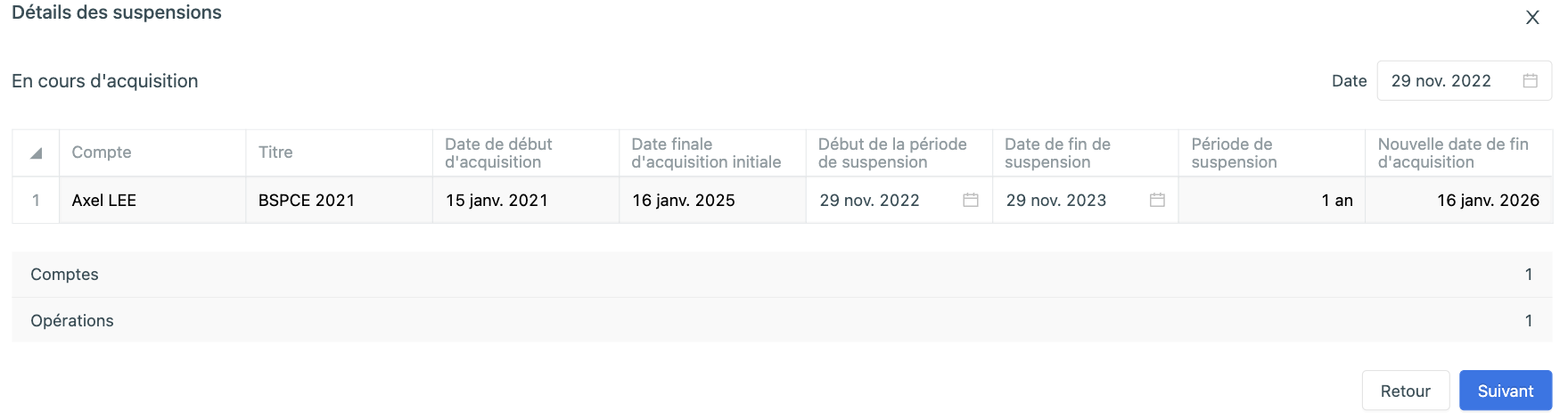 In this regard, check out our “Suspension of Security Vesting” feature
The safest approach is to avoid any unanticipated case-by-case management. In practice, it is advisable to determine (1) whether vesting should be suspended in the event of a suspension of the employment contract, (2) under what circumstances and according to what potential exceptions, and then (3) to clearly formalize these rules in the plan’s terms and conditions and the grant documentation, while establishing appropriate operational oversight.
When multiple plans coexist, implementing a dedicated management tool generally helps minimize calculation errors, ensure consistency in processing, and provide a solid basis for decisions prior to capital transactions.
Are you preparing a fundraising? Here is a checklist of all the steps to follow!
The exercise schedule, known as "vesting", is an important modality of the BSPCE allocation plan. What are the best practices in this area?
What is a capitalization table? What is it used for? How do you manage it? We explain everything to you!