According to the founding principles of venture capital, investors and employee shareholders in startups generally reap the rewards of their investments and hard work during a liquidity event (initial public offering, buyout). But when these events become less frequent, the issue of liquidity for shareholders and employees becomes a matter of governance, motivation, and the clarity of the equity story.
A gradual recovery in the IPO and M&A markets
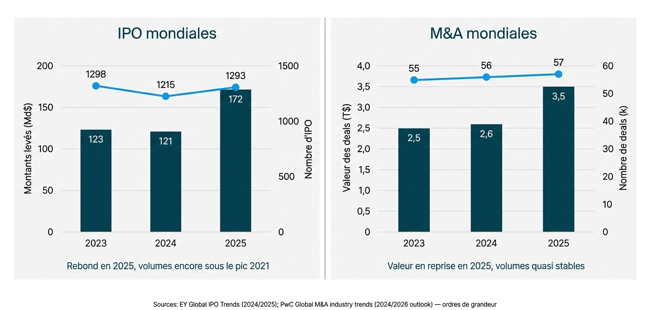
After a period of slowdown, the IPO market has been showing signs of a more steady recovery since 2024 (depending on the region and sector), and M&A activity is picking up again in a more selective manner (with a return of megadeals).
Consequently, liquidity is becoming more reliable in the medium term for some startups (IPO/M&A), but it remains cyclical. The secondary market therefore retains its value as a tool for liquidity management and governance, especially when the timing of IPO windows does not align with shareholders’ needs.
Global IPOs & M&A (2023–2025)
A disconnect between the timelines of early investors and employees and those of the company
Even though liquidity windows (IPOs/M&As) are more open than they have been over the past two years, they remain cyclical, selective, and difficult to “time” from a startup’s perspective. As a result, early investors, early employees (and sometimes former employees) may find themselves holding onto their shares longer than expected due to the lack of a “viable” window (i.e., one with aligned market conditions, valuation, and governance).
In this context, the tension stems not only from a “closed” market but also from a mismatch in time horizons: some shareholders may seek faster liquidity (or value preservation), while the board may prioritize a long-term trajectory (growth, profitability, preparing for an exit under better conditions). Without a clear framework (rules, volumes, eligible groups, governance), this mismatch can create friction and undermine good governance.
The Secondary Market: An Alternative Liquidity Strategy That Benefits Society
In a context where neither M&A nor IPOs currently appear to be the preferred exit strategies, the secondary market is increasingly emerging as a complementary and necessary strategy that companies would be well advised to pursue.
Before considering a secondary market transaction, it is essential to fully understand its unique dynamics.
Unlike a traditional fundraising round, the secondary market is not intended to provide new financing for the company, but rather to allow a new investor to join the equity structure by replacing other shareholders (investors or employees) who will transfer their shares to the new investor.
For the shareholders involved, this provides an opportunity to realize their gains without having to wait for a potential initial public offering (IPO) or acquisition of the company.
Although still viewed negatively within the ecosystem, a well-executed secondary transaction involving the right stakeholders can be a key step for the company’s future.
But to achieve this, we need to debunk the myths surrounding secondary transactions and understand their rules, so that they can be seen as a positive signal by the market.
Myths about secondary market transactions—or common misconceptions to avoid:
1. A secondary school education sends the wrong signal in an equity story
If the goal is to buy out the majority of your company’s executives and key employees, there is no doubt that this move will send the wrong signal to the market. It’s important to note that this would also be the case for a Series A funding round. This may suggest that the company no longer enjoys the trust and support of its key internal stakeholders, which can raise concerns and skepticism among potential investors.
However, in certain situations, a secondary round can be a sound strategic choice. For example, if you’re looking to replace shareholders who have already contributed everything they could—whether in terms of resources, knowledge, or skills—with new investors who are capable of supporting you as you move forward with your project. In this case, a secondary offering can be a positive signal for your equity story. It demonstrates that the company is able to attract new investors, a sign of positive momentum and encouraging growth prospects.
Similarly, a secondary round can be an excellent way to reward your employees. By offering them liquidity, you give them the opportunity to benefit directly from the company’s success. This approach can have a very positive impact on employee morale and contribute to a motivating and rewarding corporate culture. What’s more, by demonstrating that the company cares about its employees’ financial well-being, this new round of funding will be viewed positively both internally and externally. This can strengthen your reputation as an employer of choice and help you attract and retain talent.
2. High school is easier to handle than elementary school
Contrary to popular belief, raising a Series B funding round is more complex than organizing a Series A funding round. Several factors contribute to this complexity:
- First, the number of investment funds that focus on secondary financing is significantly lower than those that invest in primary financing. This makes it harder to access investors, as the options are more limited. Startups must therefore demonstrate greater perseverance and ingenuity to identify and attract the right investors.
- Furthermore, during a secondary financing round, investors scrutinize the company’s balance sheet, unlike in a primary financing round, where the business plan is typically the primary reference. This difference means that the company must be in a solid financial position at the time of the transaction. It is imperative that the company’s cash position be sufficiently robust so that a new round of fundraising is not necessary in the short term. This may seem obvious, but it makes little sense for an investor to commit to a secondary financing round if the company is likely to seek funding in the short term.
- Furthermore, in the context of a secondary financing transaction, preemptive rights and the hierarchy of share classes must be examined. This is a distinctive feature that differs from primary financing. It is therefore necessary to perform a valuation differentiated by asset class. This step may require more in-depth financial expertise and knowledge, adding another layer of complexity to the transaction.
- Finally, the legal complexity inherent in secondary financing transactions must not be overlooked. Between contracts, shareholder agreements, and various regulations, there are a multitude of legal details that must be taken into account. This often requires the assistance of legal experts, which can increase the cost and time required to complete the transaction.
In short, all these factors combined make secondary financing more difficult to manage than primary financing. However, with proper preparation and a dedicated team, it is entirely possible to successfully navigate this complex process.
3. The secondary selection is necessarily made at the expense of the last round
In a secondary offering, the shares being sold typically come from investors who participated in earlier funding rounds and are often classified as common stock. It is important to note that these shares are not the same as the preferred shares issued during the most recent funding round. Preferred shares generally have stronger protections and therefore offer a higher level of security to investors. Consequently, it would make sense to apply a discount—or a price reduction—to the shares sold during a secondary round. Furthermore, we are currently in an environment where valuations tend to decline between each round. This reinforces the idea that it is all the more important to consider a price adjustment when selling shares in a secondary offering.
Steps to take to approach a round with confidence:
1. Educate shareholders
It is important to note that not all parties involved in a secondary offering are necessarily well-informed about the details of the shares and their conversion process, particularly your company’s employees. Indeed, the complexity of this information can sometimes make it difficult to understand. Therefore, it is wiseto adopt a proactive education and communication strategy. For example, organizing an annual information session regarding the terms of sale for BSPCE shares, their exercise price, and other relevant information can be extremely beneficial. The main objective of this approach is to make employee stock ownership as transparent and understandable as possible for all employees. This would help prevent misunderstandings from turning employee stock ownership into a myth, which could prove disappointing for those who lack adequate information.
2. Actively Plan Your Secondary Plan
Generally, a secondary transaction is initiated either by the investment fund holding stakes in the company or by the company itself. In either case, several preliminary steps are essential. First , the timing of the transactionmust be confirmed, taking into account the economic environment and the company’s financial situation. Next, it is important to establish a precise timeline for the transaction in order to organize the various stages effectively and avoid any delays. Furthermore, it is necessaryto identify the shareholders involved in order to verify their identities (KYC). This step ensures the legitimacy of the shareholders and helps prevent potential fraud. All of these preparations are necessary to ensure that the secondary offering proceeds smoothly.
3. Avoid any aggressive preferential liquidation clauses
It is strongly recommended to avoid preferential liquidation clauses as much as possible, and more specifically any clause that deviates from the standard 1x participatingclause. Such clauses, when particularly aggressive, can often be a sign that a company is in a precarious situation or facing difficulties. In such a situation, pursuing a secondary transaction is certainly not the best strategy. Indeed, this could add an additional layer of complexity and risk to an already unstable environment. Consequently, when faced with aggressive preferential liquidation clauses, it is best to exercise caution and avoid the secondary market.
As a reminder, preferential liquidation clauses protect investors in the event of the company’s unsatisfactory performance. These clauses allow investors who benefit from them to receive a larger share of the proceeds than they would normally have received through a proportional distribution of capital.
A secondary round can be suitable for all stages of development:
- Pre-LBO: These companies, with valuations estimated between 0 and 250 million euros, are generally in the growth phase. A secondary transaction at this stage can allow early-stage investors to realize gains.
- Unicorn or Soonicorn: These companies, with valuations ranging from 250 million to 5 billion euros, have generally demonstrated rapid growth and are well-established in their sector. A secondary offering can allow them to provide liquidity to their employees and shareholders, while attracting new investors to support their continued expansion.
- Decacorn: These companies, with a valuation of more than 5 billion euros, are often market leaders with a strong international presence. A secondary offering at this stage can enable these companies to provide significant liquidity to their shareholders—including employees—while restructuring their ownership base for the next phase of their growth.r
Conclusion
When IPOs and M&A deals are slow to materialize, the secondary market can be a pragmatic strategy for alleviating liquidity pressures.
The next most useful step is often the same: set out the terms in writing (who is selling, how much, and under what conditions), verify the articles of incorporation and shareholders’ agreement, and then organize the execution (KYC/AML-CFT if applicable, documentation, account registration, and registry).
Sources
-
AMF — AML-CFT
-
AMF — PEA and Acquisition of Unlisted Securities: No Deferred Payment at the Time of Acquisition
-
BOFiP — PEA: Operating Procedures
- Commercial Code, Art. L. 228-1 — Légifrance
- Commercial Code, Art. R. 228-8 — Légifrance
- General Tax Code, Art. 150-0 B ter — Légifrance
- Law No. 2025-127 of February 14, 2025, on the 2025 Budget — Légifrance
- PwC — Global M&A Industry Trends: 2026 Outlook
- PwC - Global M&A Industry Trends
